English
 日本語
日本語 Tiếng Việt
 繁體中文
繁體中文 بالعربية
 Արմենյան
 한국어
한국어 Русский
 Türkçe
 คนไทย
คนไทย nederlands
 Română
 Gaeilgenah Éireann
 Português
 Indonesia
 Polski
 Español
 magyar
 Nederlands
 हिंदी
हिंदी Eesti
Eesti
How to choose a suitable fire hose nozzle for different environments?
Fire Hose Nozzle Selection Guide for Different Environments: Choose the Right Equipment for More Efficient Fire Extinguishing
The selection of fire hose nozzles is directly related to the efficiency and safety of fire fighting operations. Different scenarios have significant differences in environmental characteristics, fire source types and space constraints, so it is necessary to select suitable fire hose nozzles in a targeted manner. Based on common application environments, this article details the selection standards and adaptation solutions of fire hose nozzles, providing professional reference for fire engineering design and emergency reserve configuration.1. Industrial Plant Environment
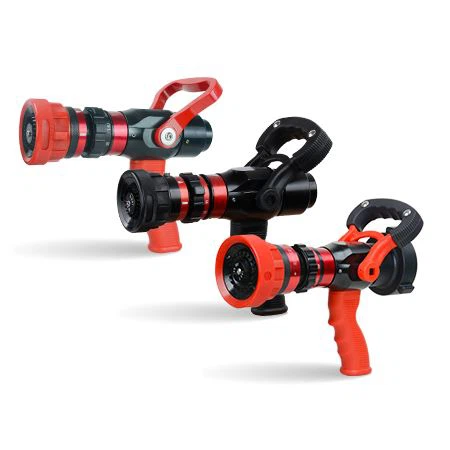
The core characteristics of industrial plants are open space, complex fire source types (such as equipment fires and chemical fires), and high-pressure or corrosive media in some areas.- Selection Points:Prioritize high-flow adjustable fire hose nozzles (flow rate ≥8L/s) that support multi-mode switching between jet, spray and mist. The jet mode can extinguish fires deep in equipment at a long distance, while the spray mode can suppress the spread of flames in chemical fires.
- Material Requirements:For chemical plants with corrosive gases or liquids, stainless steel fire hose nozzles are required; ordinary mechanical processing plants can use brass nozzles, which balance durability and economy.
- Special Adaptation:High-temperature workshops need to be equipped with fire hose nozzles with high-temperature resistant seals to prevent water leakage due to seal failure.
2. Commercial Building and Civil Residential Environment
Commercial buildings (such as shopping malls and office buildings) and civil residences are characterized by narrow space, dense personnel, and solid combustibles (such as furniture and textiles), with high requirements for the accuracy and safety of fire extinguishing.- Selection Points:Recommended use of medium-flow lightweight fire hose nozzles (flow rate 3-5L/s), which are small in size and light in weight, easy for personnel to operate quickly, and suitable for indoor fire hydrant systems.
- Function Requirements:Prioritize adjustable nozzles with non-slip handles that support switching between jet and spray modes. The spray mode can reduce water damage to surrounding items during fire extinguishing.
- Installation Adaptation:It must match the indoor fire hose connector specification (usually DN65) to ensure quick and leak-free connection.
3. Outdoor Open Environment
Outdoor open environments (such as squares, parks and construction sites) are characterized by unobstructed space, fast fire spread and long water supply distance, with high requirements for the range and flow rate of fire hose nozzles.- Selection Points:Use high-flow long-range fire hose nozzles (flow rate ≥10L/s, range ≥30m), mainly in jet mode, which can quickly suppress large-area outdoor fires.
- Material Requirements:Outdoor environments are prone to wind and rain, so brass or stainless steel nozzles with anti-rust treatment are required, and the connector part is equipped with a waterproof sealing sleeve.
- Special Adaptation:Construction sites can use nozzles with anti-collision protective covers to prevent damage from collisions during construction; spray nozzles are recommended for areas around forests to effectively block the spread of fire.
4. Marine and Ocean Environment
The core characteristics of marine and ocean environments are high humidity, high salt spray corrosion, narrow space, and fire sources mostly being fuel and electrical equipment fires.- Selection Points:Must use marine-specific fire hose nozzles that meet the certification standards of classification societies, supporting dual modes of jet and spray. The spray mode can be used for fire extinguishing of electrical equipment fires.
- Material Requirements:All stainless steel or copper alloy materials with anti-salt spray corrosion treatment on the surface to ensure long-term stable operation in high-humidity environments.
- Function Requirements:Equipped with a quick connector locking device to prevent the nozzle from falling off the hose due to ship vibration and ensure continuous water supply.
5. Low-Temperature and Frigid Environment
Low-temperature and frigid environments (such as northern winters and cold storage) are characterized by low temperatures and easy freezing, with extremely high requirements for the cold resistance and sealing performance of fire hose nozzles.- Selection Points:Use cold-resistant fire hose nozzles with seals made of low-temperature resistant rubber materials (which can work normally at -40℃) to prevent valve jamming caused by freezing.
- Material Requirements:Brass nozzles have better cold resistance than plastic nozzles and are not easy to crack due to sudden temperature changes.
- Use Adaptation:When stored for a long time, the water in the nozzle must be drained to avoid damage to the nozzle body due to freezing expansion.
Summary of Core Selection Principles
- Match Fire Source Type:Adjustable nozzles are preferred for solid fires, spray nozzles for liquid fires, and special nozzles with qualified insulation performance for electrical fires.
- Adapt to Environmental Conditions:Stainless steel materials for corrosive environments, cold-resistant types for low-temperature environments, and long-range types for outdoor environments.
- Comply with System Parameters:The connector specification and flow rate of the nozzle must match the parameters of the fire hose and fire hydrant system to avoid insufficient water supply or incompatible connectors.